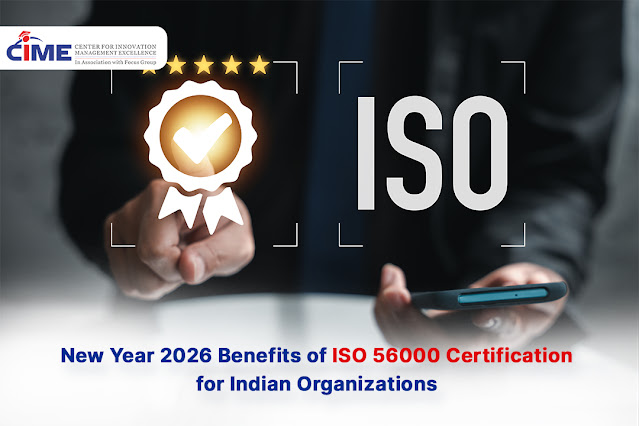
New Year 2026: Benefits of ISO 56000 Certification for Indian Organizations
As India steps into 2026, organizations across industries are redefining how they grow, compete, and stay relevant in a rapidly transforming global economy. Digital acceleration, AI adoption, sustainability goals, and global competition have made one thing very clear—innovation can no longer be accidental. It must be structured, measurable, and aligned with long-term strategy. This is where ISO 56000 certification emerges as a powerful game-changer for Indian organizations aiming to lead rather than follow.
In the New Year, companies that invest in structured Innovation Management will not only survive market disruptions but also unlock sustainable growth, stronger brand credibility, and global recognition.
Why 2026 Is the Right Time for Indian Organizations to Focus on Innovation
The Indian business ecosystem is evolving faster than ever. Startups are scaling globally, MSMEs are adopting digital tools, and large enterprises are rethinking legacy systems. However, innovation without direction often leads to confusion, wasted resources, and missed opportunities.
As we enter 2026, organizations are realizing that innovation must be systematic, not reactive. The ISO 56000 certification provides a globally accepted framework that helps businesses manage innovation in a structured, repeatable, and scalable manner. It transforms innovation from a buzzword into a core business capability.
Understanding ISO 56000 Certification in Simple Terms
The ISO 56000 certification is part of an international standard developed to guide organizations in building an effective innovation management system. Unlike traditional quality or process standards, ISO 56000 focuses on how organizations identify opportunities, generate ideas, evaluate risks, and turn innovation into value.
For Indian organizations, this certification brings clarity and consistency in innovation efforts—whether it’s developing new products, improving internal processes, or responding to changing customer expectations.
.jpg)
Key Benefits of ISO 56000 Certification for Indian Organizations
1. Structured Innovation Instead of Trial and Error
Many Indian organizations rely on informal brainstorming or isolated innovation initiatives. While creativity is important, lack of structure often leads to inconsistent outcomes. ISO 56000 certification introduces a clear framework for Innovation Management, helping teams move from random ideas to well-defined innovation pipelines.
This structured approach reduces uncertainty, saves time, and ensures that innovation efforts align with business objectives—something that is critical in 2026’s competitive environment.
2. Stronger Global Credibility and Market Trust
In the international market, credibility matters. Organizations with globally accepted standards are seen as reliable, future-ready, and professional. The ISO 56000 certification signals that an organization follows global best practices in Innovation Management, making it more attractive to international clients, investors, and strategic partners.
For Indian companies expanding into global markets in 2026, this certification becomes a strong trust-building asset.
3. Improved Decision-Making and Risk Management
Innovation always involves risk—but unmanaged risk can be costly. One of the biggest advantages of ISO 56000 is that it encourages informed decision-making. It provides tools to assess feasibility, impact, and risk before investing heavily in new ideas.
By adopting structured Innovation Management Programs, organizations can experiment intelligently, fail faster when needed, and scale successful ideas with confidence.
4. Boost in Employee Engagement and Innovation Culture
As workforce expectations evolve in 2026, employees seek more than just job security—they want purpose, creativity, and growth. Organizations that invest in innovation frameworks create an environment where employees feel empowered to contribute ideas.
ISO 56000 promotes a culture of collaboration, learning, and continuous improvement. This leads to higher employee engagement, better retention, and stronger internal alignment—key priorities for Indian organizations facing talent competition.
5. Enhanced Competitiveness in Indian and Global Markets
Markets are becoming more crowded and customer expectations are rising. Businesses that fail to innovate systematically struggle to differentiate themselves. The ISO 56000 certification helps organizations continuously refine their offerings, improve customer experience, and stay ahead of competitors.
In 2026, competitiveness will be defined not by size, but by an organization’s ability to adapt and innovate consistently through effective Innovation Management.
6. Alignment Between Innovation and Business Strategy
One common challenge Indian organizations face is the disconnect between innovation initiatives and overall business strategy. ISO 56000 bridges this gap by ensuring that innovation goals are directly linked to organizational vision, market needs, and long-term growth plans.
This strategic alignment makes Innovation Management Programs more impactful, measurable, and sustainable—especially important in a year where ROI-driven decision-making will dominate leadership agendas.
7. Support for MSMEs, Startups, and Large Enterprises Alike
One of the biggest strengths of ISO 56000 is its flexibility. Whether it’s a startup, MSME, PSU, or multinational enterprise, the framework can be adapted to suit different scales and sectors.
For Indian MSMEs in 2026, ISO 56000 offers a roadmap to compete with larger players. For startups, it provides discipline without limiting creativity. For large enterprises, it helps modernize innovation practices across departments.
.jpg)
Role of Innovation Management Programs in 2026
As innovation becomes a leadership priority, Innovation Management Programs will play a crucial role in helping professionals and organizations understand and implement ISO 56000 principles effectively.
These programs build capabilities such as:
Opportunity identification
Design thinking and problem-solving
Innovation portfolio management
Strategic foresight
Change and transformation leadership
Indian organizations investing in such programs will be better prepared to leverage the full benefits of ISO 56000 certification and stay competitive in the evolving business landscape of 2026.
Why ISO 56000 Is a 2026 Innovation Trend
In 2026, global businesses are moving away from unstructured innovation towards standardized innovation systems. Governments, corporations, and institutions are recognizing innovation as a measurable, manageable discipline.
For Indian organizations, adopting ISO 56000 certification is not just about compliance—it is about future readiness. It reflects a mindset shift from short-term problem-solving to long-term value creation.
The New Year 2026 presents a powerful opportunity for Indian organizations to rethink how they innovate, grow, and compete. In a world defined by uncertainty and opportunity, structured Innovation Management is no longer optional—it is essential.
The ISO 56000 certification offers Indian organizations a globally recognized framework to build sustainable innovation capability, enhance credibility, empower employees, and drive long-term success. Combined with the right Innovation Management Programs, it equips businesses to lead confidently in both Indian and international markets.
As we move forward into 2026, organizations that embrace structured innovation today will be the ones shaping tomorrow.
To learn more about ISO 56000 Certification and Innovation Management Programs, visit www.cimepro.in or connect with our experts at +91 9589706358.